Previous “Space” posts

Lenticular Cloud at Sunset ∞

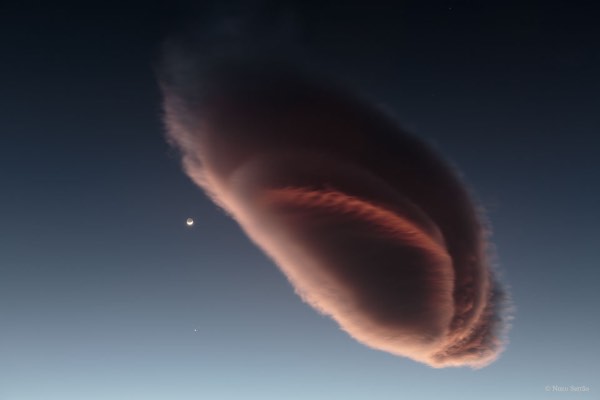
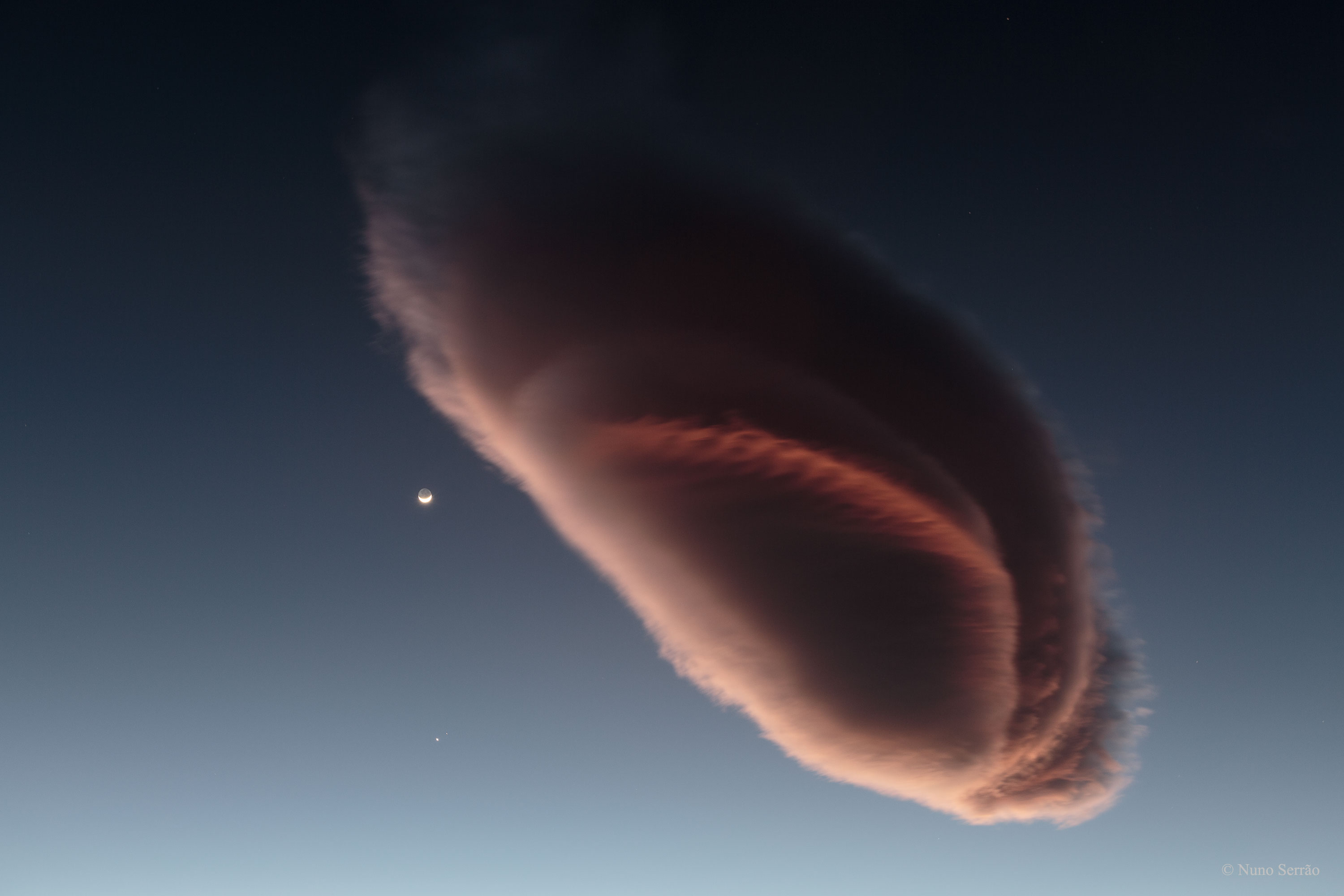
Each day, NASA’s Astronomy Picture of the Day (APOD) offers “a different image or photograph of our fascinating universe is featured, along with a brief explanation written by a professional astronomer”. While I often skip over these in my daily reading of the entire Internet from beginning to end, Monday’s post was bizarre enough to catch my eye.

Lenticular Cloud, Moon, Mars, Venus
[Photo credit: Nuno Serrão]

Though it ruined the photographer’s intended shot, this cloud gave him an image that looks unreal. Be sure to visit the site to see the full-sized image.

Goodbye Forever ∞

Elon Musk is perhaps the most fascinating man in tech. He’s working to transform the vehicle markets of Earth with Tesla, makers of electric vehicles. With SpaceX, he’s already changed the game for travel to the stars as well. As NASA has lost its cutting-edge nature, SpaceX has stepped in to fill the void, with dreams of interplanetary travel. Aeon magazine has a fascinating profile on Musk and the future of space travel.

I found this particular view of space colonization to be quite captivating:

Musk told me this first group of settlers will need to pay their own way [to Mars]…My rough guess is that for a half-million dollars, there are enough people that could afford to go and would want to go. But it’s not going to be a vacation jaunt. It’s going to be saving up all your money and selling all your stuff, like when people moved to the early American colonies.’

The idea of visiting Mars is an interesting one. The idea of moving there permanently, as people moved to a new continent just a few hundred years ago, is truly fascinating.

We Are Now in Command ∞

The ISEE-3 Reboot Project is an attempt by private citizens (with the cooperation of NASA) to resurrect communications with a decades-old spacecraft, one which had been abandoned and was believed unreachable. On May 29th, the team successfully took control.

For a good quick summary, see this XKCD comic. Who doesn’t love a good “Hackers” reference?

Space Etiquette ∞

Back in June, Astronaut Don Pettit posted a wonderful guide to hosting a dinner party in space.

The image of an insect sucking the juices from some lower insect may come to mind, but in space it is considered impolite to give voice to such imagery.

Despite being a month and a half old, I just saw this post, and it’s still definitely worthy of being shared.

Dare Mighty Things

Look at what we can do.

Last night, the United States (and all of humanity) landed a rover known as Curiosity on the planet Mars. We’ve managed to place a rover on Mars three times before, but never in such incredible fashion. The maneuvers performed on this mission read like the stuff of fantasy, or the plot of an episode of MacGyver. If you missed it last week, NASA’s Jet Propulsion Laboratory put together a fantastic video called Seven Minutes of Terror showing exactly how Curiosity’s entry, descent, and landing (EDL) worked.1

Watching that video is well, well worth five minutes, but here’s a summary of the steps it took to get Curiosity from above Mars down to its surface.

  • Eight months after being launched from Earth, Curiosity entered Mars’ atmosphere. Its heat shield withstood temperatures of as much as 2000 degrees Celsius while slowing from 13,000 miles per hour.

  • As the craft was slowed by the atmosphere, it was also self-guiding towards a very specific landing spot, constantly adjusting course to get close.

  • When Curiosity got down to 1000 mph, a supersonic parachute was deployed to continue slowing the descent.

  • After the parachute was deployed, the heat shield needed to be fired away so that the radar system could scan the ground for its landing.

  • With its parachute only capable of slowing the craft to about 200 mph, Curiosity needed to cut it off for the next stage. Rockets, thrusting away from Mars, were then used to slow the descent further and divert away from the parachute.

  • The rockets next lowered the rover towards the surface. However, due to the dust this descent stage could kick up, the rocket engines could not get too close to the surface itself. How do you place a rover on the ground, if you can’t set down on the surface?

  • Why not use a sky crane? Yes, while the descent stage was hovering above Mars, it lowered Curiosity down on a tether.

  • Finally, once the rover was on the ground, the descent stage cut itself from Curiosity and flew away for a planned crash landing safely away from Curiosity.2

So that’s how you land a one-ton, car-sized, nuclear-powered rover on a planet 150 million miles away. And oh, one other thing? Because of the 28 minute round-trip for radio signals between Mars and Earth, this all had to be done automatically, with no human intervention whatsoever. We could only sit back and wait to hear word of our success or the deafening silence which would indicate failure. Guided entry, parachute descent, powered descent, and an honest-to-goodness hovering sky crane, all pre-programmed to be able to handle anything an inhospitable foreign planet could throw at us. And we pulled it off.

Some might question why we should explore space, particularly when we are beset by so many terrestrial problems. Dr. Ernst Stuhlinger provides a wonderful response with a letter penned 42 years ago. The simple answer is that research and discovery are two of the greatest tools we have to solve problems, whether those problems are hundreds of millions of miles away or right here on Earth. It’s impossible to know what benefits we’ll reap from this incredible mission, but history tells us they will be great and they will be plentiful.

Many pictures will be received from Mars in the coming days, weeks, and months. They’ll come in color, from higher-quality cameras yet to be deployed. However, I think this prosaic shot of Curiosity’s shadow, one of the very first images it sent back, has a beauty all its own.

Curiosity on the surface

Look at what we can do.


Footnotes:

  1. That video is archived here. It also contains the inspiration for the title of this post, which originates in an FDR speech entitled “The Strenuous Life”. ↩︎

  2. While it’s silly to anthropomorphize machinery, this still strikes me as a sad but noble death. ↩︎

Shuttle Engine: Free. Must Arrange Shipping. ∞

As for the space shuttle main engines, those are now free. NASA advertised them in December 2008 for $400,000 to $800,000 each, but no one expressed interest. So now the engines are available, along with other shuttle artifacts, for the cost of transportation and handling.

Alright friends, we missed our shot at a T-Rex skeleton. I don’t expect you to chip in for a whole shuttle. But we can surely raise the money to cover shipping for a mere 7000 pound engine.

We’ll keep it at my house, and anyone who contributes can come visit whenever they like.

This Isn’t Helping ∞

NASA literally taped over the original moon landing videos. Now, a Hollywood company named Lowry Digital is restoring them and providing fuel for moon hoax conspiracy theorists for decades to come.