Recently, Facebook Meta unveiled Muse, their “personal AI agent built for everyone”. Muse goes beyond just being a chatbot, and will attempt to help accomplish actual tasks. From their introductory post:
Muse…doesn’t just answer questions, it actually does the work. It helps people stay on top of things, takes tasks and projects off their plate, and turns long-term goals into action plans.
Meta built Muse from the ground up to be a safe, secure, private, and widely available personal AI agent.
Each person stays in control of their Muse and decides how much access it gets.
Of course, the first big story about Muse was how it read a journalist’s text messages without his permission. Oops. But sure, we should definitely trust Meta with our data this time.
Despite the obvious privacy concerns, the potential of this technology is impressive. That same introductory post states that Muse “takes on more of the work so people can focus on what matters to them”. A.I. taking care of busywork and drudgery is undeniably compelling.
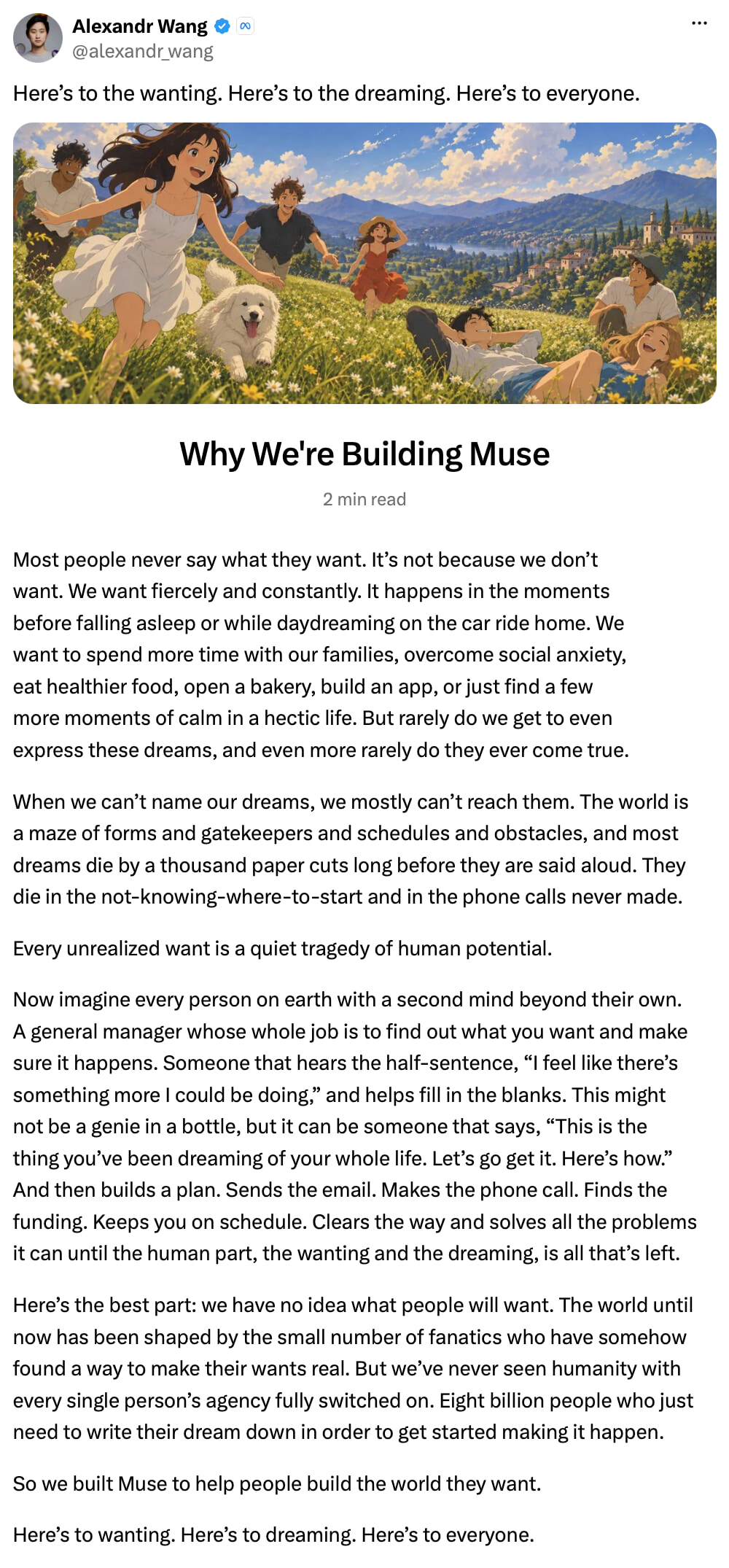
However, Meta’s Chief A.I. officer Alexandr Wang provided a somewhat different pitch. He posted an article entitled “Why We’re Building Muse”.1 I found it abhorrent, and for weeks now, I’ve been unable to let it go.
What first jumped out at me was this description of Wang’s ideal Muse:
[I]t can be someone that says, “This is the thing you’ve been dreaming of your whole life. Let’s go get it. Here’s how.” And then builds a plan. Sends the email. Makes the phone call. Finds the funding. Keeps you on schedule. Clears the way and solves all the problems it can until the human part, the wanting and the dreaming, is all that’s left.
To me, that sounds absolutely awful. Wang appears to be saying that the only human part of living is the wanting and the dreaming. Absolutely not. Doing, doing is the thing.
I may want to run a sub-3 hour marathon or write a best-selling book. But those end results are not actually the point. Accomplishing them (or not) is where the humanity truly lies. If I am able to bring about those things through effort, to earn them, I will feel a sense of achievement. By contrast, if they are simply handed to me by a machine, they will be devoid of meaning. They will be nothing.
This complete failure to recognize the joy of doing sickens me. It also shows an utter lack of understanding of what leads to humans feeling fulfillment.
But perhaps the single most glaring line in this piece is when Wang makes the claim that “Every unrealized want is a quiet tragedy of human potential.” No. No, it is not. This premise is flawed, and indeed, revolting.
If we think, for example, of people dying from lack of food, a statement like “every unrealized need is a quiet tragedy of human potential” sounds correct. But wants? Humans have an infinite number of wants, and they’re often contradictory. Some people have bad wants. Every want should, without a doubt, not be met.
This confusion between the concepts of “needs” and “wants” poisons Wang’s entire piece. It would be incredible if society could meet the needs of every human. It would be disastrous to meet the wants of every human.
Ultimately, I am repulsed by the underlying idea that my role as a human being should be to want and let the machines take care of the rest. We are not simply vessels to receive ceaseless pleasure and enjoyment, to have our every want met, with no effort on our part. Being human is about doing things yourself, and with others. It’s about accomplishing things. If A.I. can assist us, great. But we damned sure ought to be doing more than simply “wanting”.
Wang closes his piece with this call-to-arms:
Here’s to wanting. Here’s to dreaming. Here’s to everyone.
Not “Here’s to accomplishing”. That word is entirely absent from Wang’s manifesto, and that absence speaks volumes.
Footnotes:
A screenshot of the full post is archived here. ↩︎