Previous “Space” posts

An Accidental Space Record 

So he’s got that going for him.

NASA astronaut Frank Rubio was supposed to spend six months in space. Things did not quite work out that way, with Rubio’s return delayed by half a year. I’ve been finding myself alternating between horror and bemusement at how that might have played out.

  • “Well folks, I’m excited to be coming home next week! Oh…what’s…no? A delay? Huh, OK. Well, how long, a day or two? Oh. Oh I see.”

When Rubio comes home later this month, he’ll at least have earned a new American space record.

Personally, I Prefer Big Dogs 

I also like them to live for more than 10 hours.

Over on Mars, NASA has been generating oxygen. That’s very cool!

When the Perseverance rover touched down on Mars in February 2021, one of the instruments it carried was a 40-pound, microwave-sized device called the Mars Oxygen In-Situ Resource Utilization Experiment, aka MOXIE.

MOXIE has been working over the last 2.5 years to extract the trace amounts of oxygen from Mars’ atmosphere, which is mostly carbon dioxide (95%) and nitrogen (3%). On its 16th and final run on August 7, the instrument made 9.8 grams of oxygen, bringing the total to 122 grams.

However, the current results from MOXIE aren’t exactly jaw-dropping on their face. In fact, the headline “NASA generates enough oxygen on Mars for a small dog to breathe for ten hours” sounds more than a little ridiculous. In truth, however, this system has worked even better than expected. In the future, it’s possible that large dogs could breath for weeks, months, or even years on Mars. Also, humans, I suppose.

No Need to Book a Table for Dinner Yet 

What a relief!

When it comes to popular date nights, it’s wise to plan ahead. That said, you can perhaps hold off on scheduling a romantic night out for Valentine’s Day 2046. On that day, a recently discovered asteroid may crash into Earth.

The Pillars of Creation, Remastered 

The Webb is really good, y’all.

Back in July, I posted about the first images NASA showed from the new James Webb Space Telescope. I followed up with a second post showing off comparisons between the Webb and the old Hubble telescope.

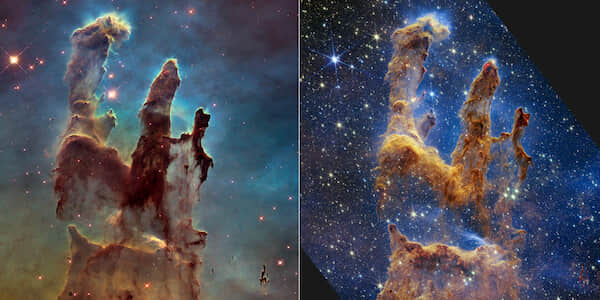
Now, NASA has another new comparison image, recreating a 1995 shot called “The Pillars of Creation”. Once again, it is something to see.


[Photo credit: NASA]

I’m still amazed at just how high quality these images are.

Happy Birthday, Curiosity 

Keep daring mighty things.

Almost exactly one decade ago, the Curiosity rover landed on Mars in truly incredible fashion.1 One year later, the robot was programmed to hum “Happy Birthday” to itself, which is somehow simultaneously adorable and deeply sad. In subsequent years, however, there was no celebration.

This year, in a marketing gimmick that’s still worth writing about, robots on earth will do the singing. Autonomous home lawn mowers from Husqvarna will be able to serenade Curiosity, and that’s pretty great.

I don’t have a lawn, and thus have never shopped for a robot lawn mower. However, thanks to this stunt, I’ve learned that Husqvarna’s mowers look like tiny Batmobiles:

That’s pretty great too.


Footnotes:

  1. While writing this post, I once again watched NASA’s “Seven Minutes of Terror” video. Everything about it still fills me with awe. ↩︎

The Universe in High Definition 

Hubble images were once stunning, but they're wet garbage now.

When I posted about the new James Webb Space Telescope on Tuesday, I also linked to a similar image from the Hubble. Now, there’s a fantastic site to compare images between the two space telescopes: WebbCompare.com.

Two similar images, one lower quality from the Hubble, and one much higher quality from the Webb
Left: Hubble; Right: Webb

It’s not unlike the switch from standard definition television to HD. It’s a stark and astounding improvement.

A Glimpse at the Universe 

Look at what we can do.

The James Webb Space Telescope is the most powerful telescope ever launched into space. It’s a remarkable tool, one which will enable us to see objects which the once top-of-the-line Hubble couldn’t make out because they’re too distant, too faint, or too old. In the past 24 hours, NASA has unveiled the first images from the Webb, and they are simply remarkable.


“Cosmic Cliffs”

This image is stunning, but all the more so when compared against one previously captured by the Hubble.

Perseverance’s Pet Rock 

Sorry, future Mars geologists.

One planet over, on Mars, NASA has deployed five different rovers over the years. To our knowledge, however, only one of them has a pet.


Stowaway

Yes, the Perseverance rover has acquired a pet rock, and that’s adorable.

They’ll Have to Follow-Up on That One 

Yeah, could you just change the course of the moon's orbit a little bit?

Texas congressman Louie Gohmert has never been thought of as the brightest crayon in the box. However, his recent question to the U.S. Forest Service was enormously stupid on two distinct levels.

Making Human Exploration of Mars Possible 

Don't take it, just make it when you get there.

As you might be aware, humans need oxygen to live. Earth has a good supply of it, but other planets do not. Thanks to a recent experiment by NASA, however, Mars has a bit more oxygen than it previously did.

“MOXIE isn’t just the first instrument to produce oxygen on another world,” Trudy Kortes, director of technology demonstrations within NASA’s Space Technology Mission Directorate, said in a statement. She called it the first technology of its kind to help future missions “live off the land” of another planet.

The instrument works through electrolysis, which uses extreme heat to separate oxygen atoms from molecules of carbon dioxide, which accounts for about 95% of the atmosphere on Mars.

The moon landings began and ended well before I was born, but I’m hopeful that I’ll be able to witness a Mars landing in my lifetime.